
No. Napoleon's soldiers did not shoot the nose off the Great Sphinx. Two Europeans drew the monument in 1737, sixty one years before French troops reached Egypt in 1798. The one who drew what he saw drew a face with no nose already.
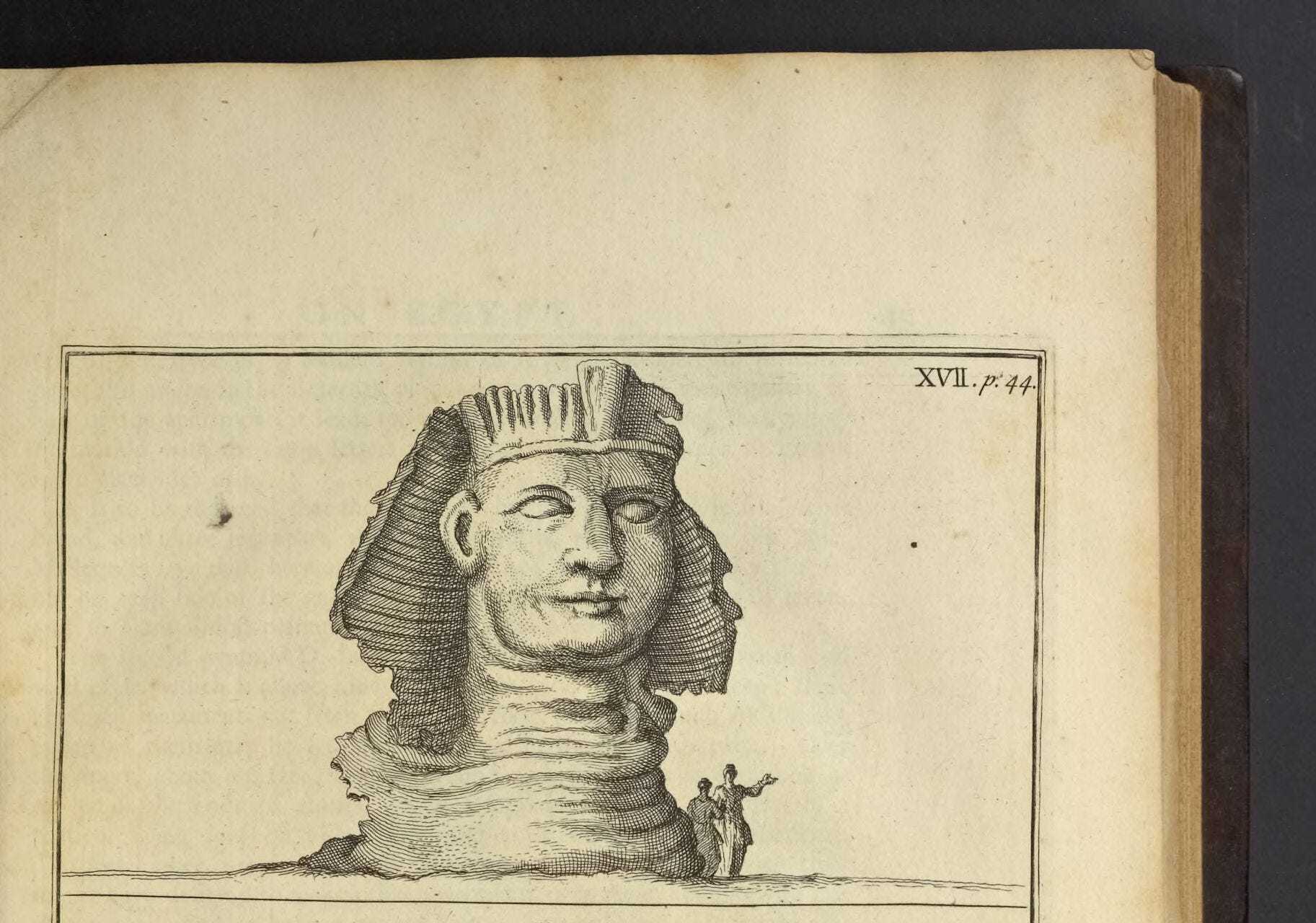
Richard Pococke stood in front of the Great Sphinx at Giza in 1737 and drew it with a nose. He was not the one who saw what was really there. Frederik Ludvig Norden did, the same year, and drew the damage exactly as the tool marks would later confirm, centuries on.
Richard Pococke and Frederik Ludvig Norden, Giza, 1737
Pococke reached Alexandria on 29 September 1737. He worked his way up the Nile, took notes and plans at Giza, came home to England in 1742, and published the first volume of A Description of the East in 1743.
His Sphinx has a nose. It also has a face that nobody standing at Giza that year could have seen.
The reason is simple. Pococke did not draw that head from life. His plate follows one Cornelis de Bruijn had published in 1698, with barely a change made to it.
He was not the first to reach for that trick. Johannes Helferich printed a Sphinx in 1579 with a full nose and the features of a woman.
Putting the missing parts back was ordinary practice.
Norden did not do it. He was a Danish naval officer, sent to Egypt by Christian VI in the same year, under orders to record what was there. He drew the head from the front, sand up to the shoulders, the face flat and wrecked.
Norden died in 1742 with none of it printed. The Royal Danish Academy of Sciences and Letters brought the work out in 1755 as Voyage d'Egypte et de Nubie, engraved by Marcus Tuscher.
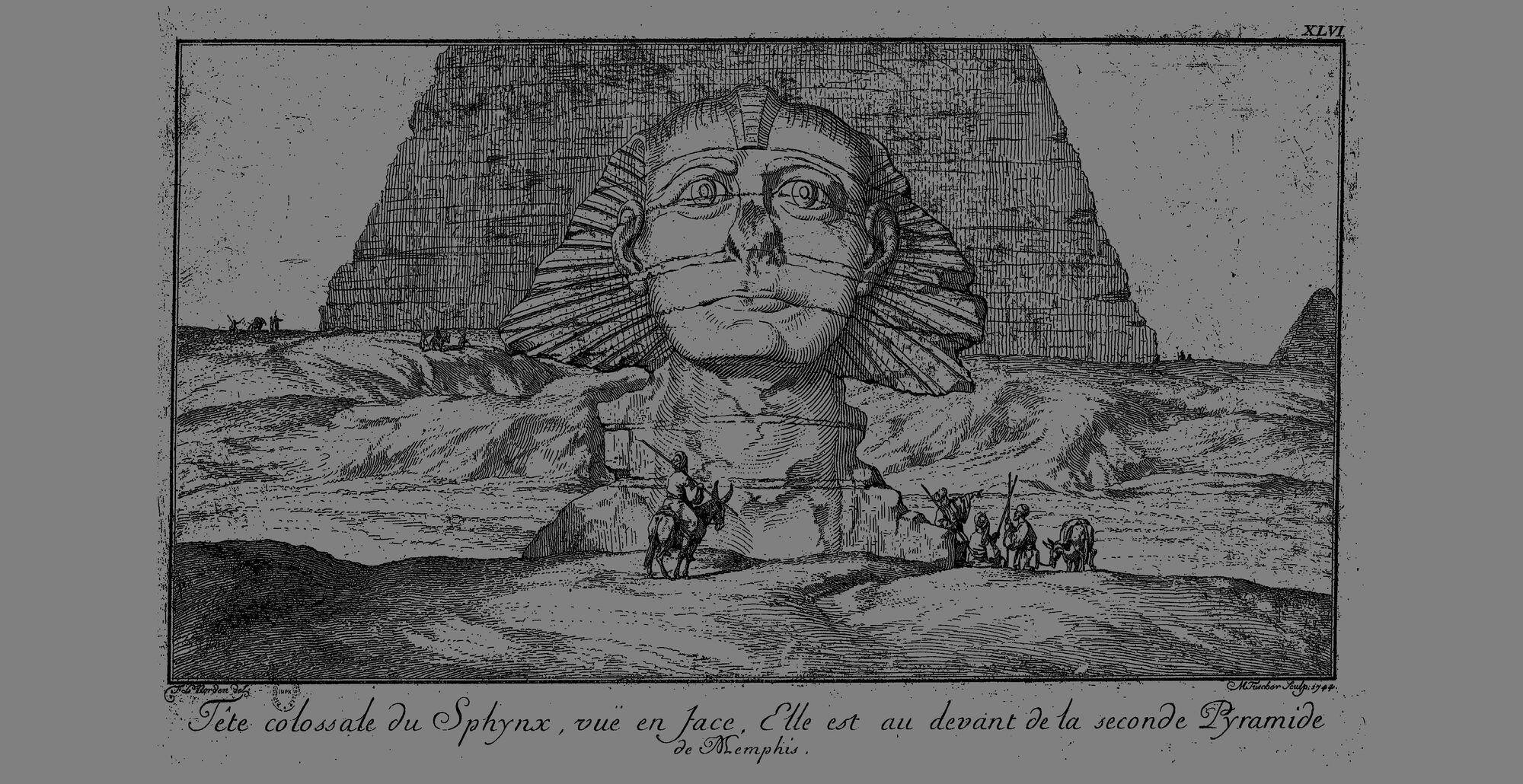
Here is the part I find more interesting than the answer itself. Pococke went on sale in 1743, Norden in 1755.
So for twelve years, the best printed image of the Sphinx that a reader in London or Paris could buy carried a nose that had been gone for centuries. No printed image on sale in Europe said otherwise.
That gap is also what makes Norden's plate hold. In a decade when draughtsmen were quietly repairing the face, one man drew the damage.
What Mark Lehner read in the break
Mark Lehner spent five years mapping the Sphinx surface by surface. On the face, he found the marks left by the tools.
Rods or chisels were driven into the nose, one down from the bridge, one underneath the nostril. The piece was then levered off towards the south.
Lehner dates that work to somewhere between the third and the tenth century AD. That puts it centuries, in some readings a full thousand years, before any of the names usually attached to it.
In the autumn of 2009, for the NOVA film Riddles of the Sphinx, Lehner and the sculptor Rick Brown tried to reproduce the job. They cut a scaled down copy of the nose from limestone in a yard near Boston, with replicas of Egyptian copper chisels and stone hammers.
The copper went blunt after a few blows every time. It kept going back to the forge.
That is the detail that closes the cannon question for me. Taking a nose off that head was days of work by people who arrived equipped for it, and no gun leaves marks like the ones Lehner recorded.
The name Cairo wrote down: Muhammad Saim al Dahr
The oldest named culprit is Egyptian, and he predates the French by four centuries.
Al Maqrizi, writing in the fifteenth century, recorded that the nose and the ears of the Sphinx were destroyed by Muhammad Saim al Dahr, a Sufi from the khanqah of Said al Suada in Cairo.
The motive he gives is religious correction. Egyptians were still burning milk thistle and safflower at the foot of the statue and repeating a verse sixty three times in the hope of getting what they asked for.
Al Maqrizi puts the act in 1378. He was born in 1364, so he was writing about something he never saw.
Then the stone disagrees with the paperwork, because Lehner's dating of the break sits far earlier than any medieval account.
Both versions describe a tool in someone's hands. Neither of them describes a shot.
More true stories from the past
If Lehner's tool marks got you, three more mysteries worth your time.


Louis Farrakhan, Washington, 16 October 1995
The Napoleon version has no source anyone has found before the twentieth century. Tom Holmberg went looking for one on behalf of the Napoleon Series and came back with a guide's patter.
James Morgan printed it in 1915 as “a tradition among the Arabs of the Pyramids”, and dismissed it in the same paragraph as “only a legend for the tourist”.
It has the same shape as a line he never wrote: the printed trace turns up long after the man it is pinned on.
What turned tourist patter into an argument came eighty years later.
Speaking at the Million Man March in Washington on 16 October 1995, Louis Farrakhan told the crowd that “white supremacy caused Napoleon to blow the nose off the Sphinx because it reminded you too much of the Black man's majesty.”
That sentence is the reason this question is still typed into search boxes thirty years on. The Napoleon version suited the argument, because it came with a European army and a name everyone already knows.
It has outlived every correction since, which is roughly the fate of the rest of what people repeat about Napoleon.
Ridley Scott brings the cannon back, 2023
Ridley Scott's Napoleon reached cinemas in November 2023 with the scene played straight: French guns firing on the pyramids, the Sphinx losing its face on camera.
Asked about it by The Times, Scott said he did not know whether Napoleon had done it, and that it was a fast way of saying he took Egypt.
Michael Broers, the historian who advised the production, has said Scott knew nothing like that had happened.
Painters were doing the same favour for Napoleon long before cinema existed, at the bridge he never crossed and in the hand tucked inside his coat.
The geography is the other problem with the scene. The fighting of 21 July 1798 that we call the Battle of the Pyramids happened at the village of Embabeh, with the pyramids roughly ten miles away.
There is a piece of the Sphinx in Room 4 of the British Museum
Giovanni Battista Caviglia cleared the space between the Sphinx's paws in 1817 and found fragments of its beard there. One piece reached London in 1818, other fragments are in the Egyptian Museum in Cairo. The nose, about a metre of limestone, has turned up in neither city.
It is registered as EA58: a block of limestone, 78.7 centimetres high and 51.5 wide, on display in Room 4.
The museum's note on it corrects a second assumption. That plaited beard was probably never part of Khafra's monument.
It reads as 18th Dynasty work, most likely ordered by Thutmose IV when he cleared and repaired the Sphinx more than a thousand years after it was carved.
The tip of the beard curves, which marks the wearer as a god. A king's beard was cut straight.
Short answers on the Sphinx's missing face
Who broke the Sphinx's nose? No name survives with proof behind it. Mark Lehner's reading of the tool marks puts the removal between the third and the tenth century AD, done with rods or chisels driven into the stone and levered sideways.
When did the nose disappear? Before 1737 for certain, since Norden drew the head without it that year. The accusation written in Cairo is older still and points to the late fourteenth century.
Where is the Sphinx's nose today? It has never been found. It measured about a metre across. What survives instead is a fragment of the Sphinx's beard, in London.
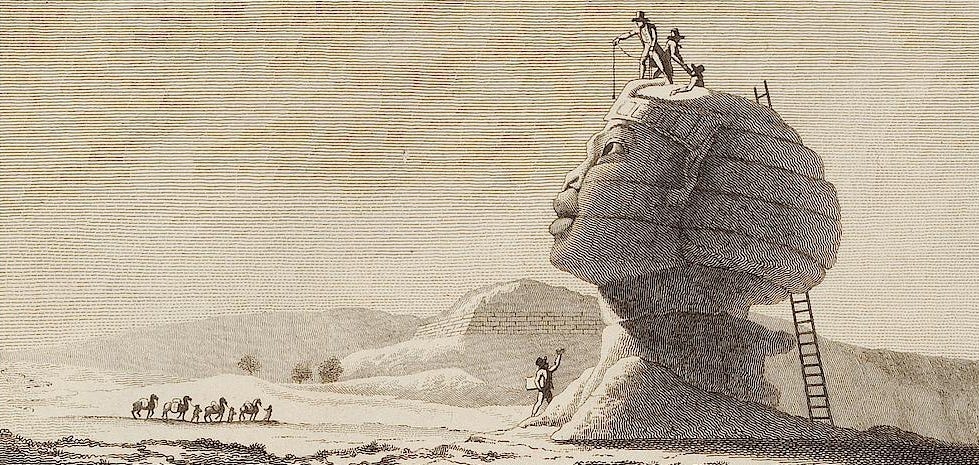
Did Napoleon's expedition damage the Sphinx? No record says so. The scholars Napoleon brought with him measured the monument and published engravings of a noseless Sphinx, in the atlas Vivant Denon brought back and in the Description de l'Égypte.
Why does the myth blame Napoleon specifically? His name already meant a European army in Egypt to most readers. The accusation only became an argument eighty years later, when Louis Farrakhan gave it a political meaning far stronger than a tourist guide's rumour ever had.