

Learn History the fun way.
This is a preview. Paid subscribers get the full story.
You’ll also get:
4 new stories / month
The full archive
Comment, ask questions, DM me anytime
iPhone user? Subscribe at coolstoriesabouthistory.com, not via the app. Apple adds +30% to the price.
Paris, Monday, April 15, 2019, 6:18 p.m.
A small room with pale green walls, in the presbytery next to the cathedral. One man, alone, in front of a monitoring screen. The air smells of warm plastic from the screens.
A red light comes on: Fire.
The man has been here since seven thirty in the morning; his relief hasn't shown up. Ten hours into his shift. Three days of work this month, and he has never once walked the whole building.
The security company has cut back its team: there used to be two men in this room, one for the screen, one for the rounds. Now there is only him.
On the screen, under the word Fire, a zone: attic nave sacristy. Then a code, ZDA 110 3 15 1, the number of one of the building's 160 smoke detectors. He reads the line again: the code means nothing to him.
He radios a guard posted near the altar. In the nave, evening Mass has drawn several hundred worshippers: the canon is reading the Gospel, the organ has just gone quiet.
The message crackles over the walkie-talkies. Only the first words get through: attic nave sacristy.
At 6:23 p.m., a siren blares from the loudspeakers in the middle of the reading, followed by an evacuation announcement. The worshippers rise, and the nave empties onto the square without a single shout.
Meanwhile, the guard goes up to check the sacristy, the building attached to the south flank of the cathedral. Door open, a quick sweep of the rooms: no smoke, no flames, nothing. He calls it in.
6:35 p.m. False alarm, they conclude. The alarm is switched off, the worshippers return to their chairs, the service picks up where it left off.
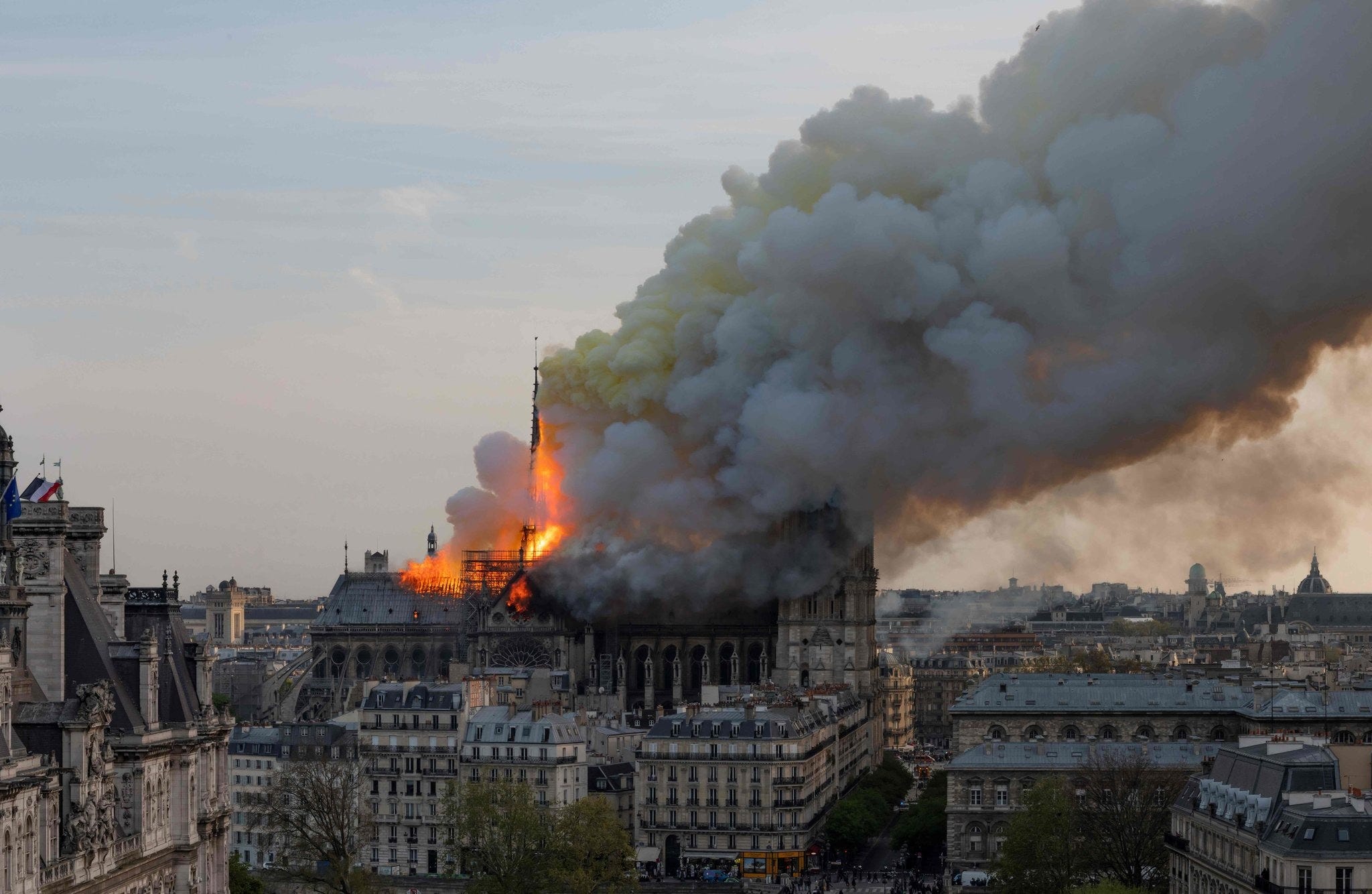
Above their heads, the roof frame is already burning: 1,300 oak trees felled in the twelfth century, more than 330 feet of timber in one unbroken run, without a single firewall.
6:43 p.m. A phone rings at the control post: the head of the security company finally explains the code.
"It wasn't the sacristy attic you needed to check. It was the attic over the nave."
For twenty-five minutes, everyone has been looking for the fire in the wrong building.
The guard takes off running, the cathedral's site manager with him. Five minutes of climbing, and when they push open the attic door, flames several yards high are already running from beam to beam. The heat stops them at the threshold. A fire extinguisher would be useless.
6:48 p.m. The Paris fire brigade is called. Thirty minutes have passed since the first red light.
Two Little Hoses
At the same moment, across Paris, at the headquarters of the Paris Fire Brigade.
General Jean-Claude Gallet, 54, the head of the brigade, hears about the fire in a call from the mayor's office. The mayor is on her way to the square in front of Notre-Dame; she would like a briefing.
"We haven't heard anything."
His deputy's phone rings while they are looking at each other. General Jean-Marie Gontier picks up.
"Apparently, Notre-Dame is on fire."
They leave without discussing it, each to his own role: Gontier takes command at the foot of the fire, Gallet handles the decisions and the officials.
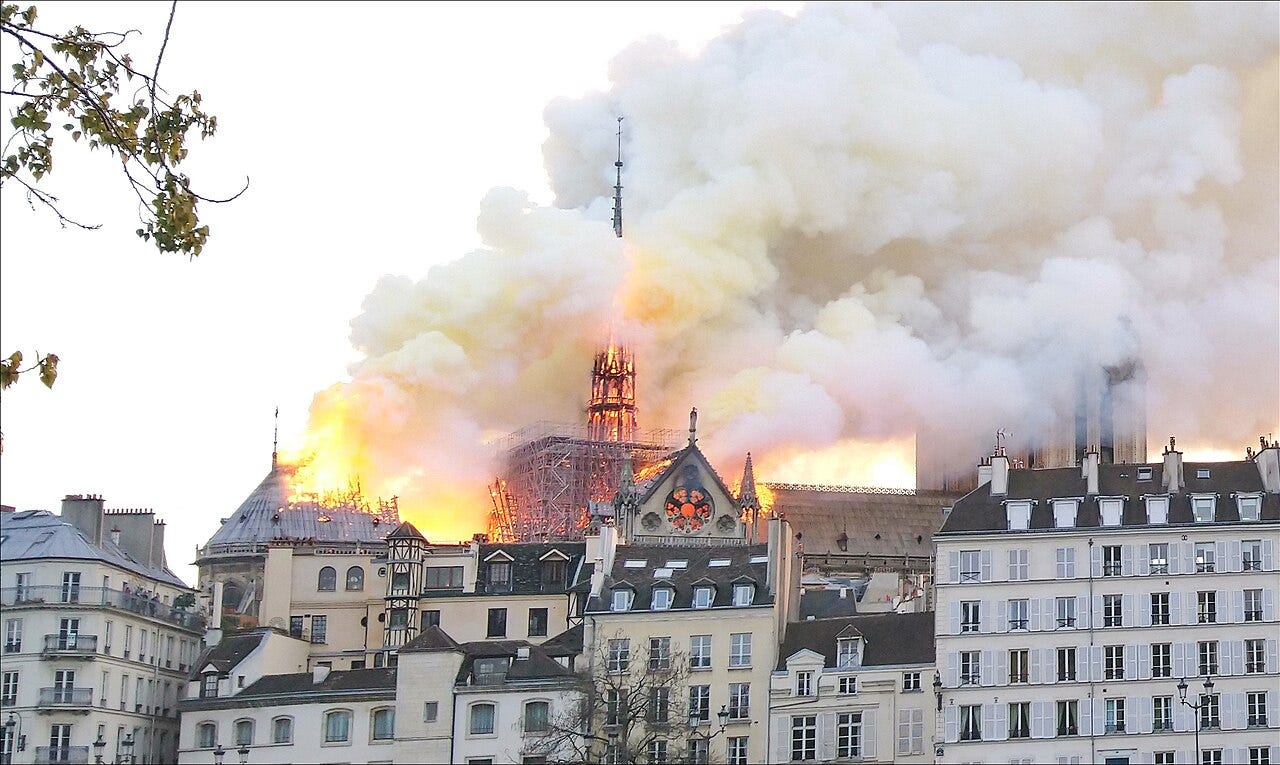
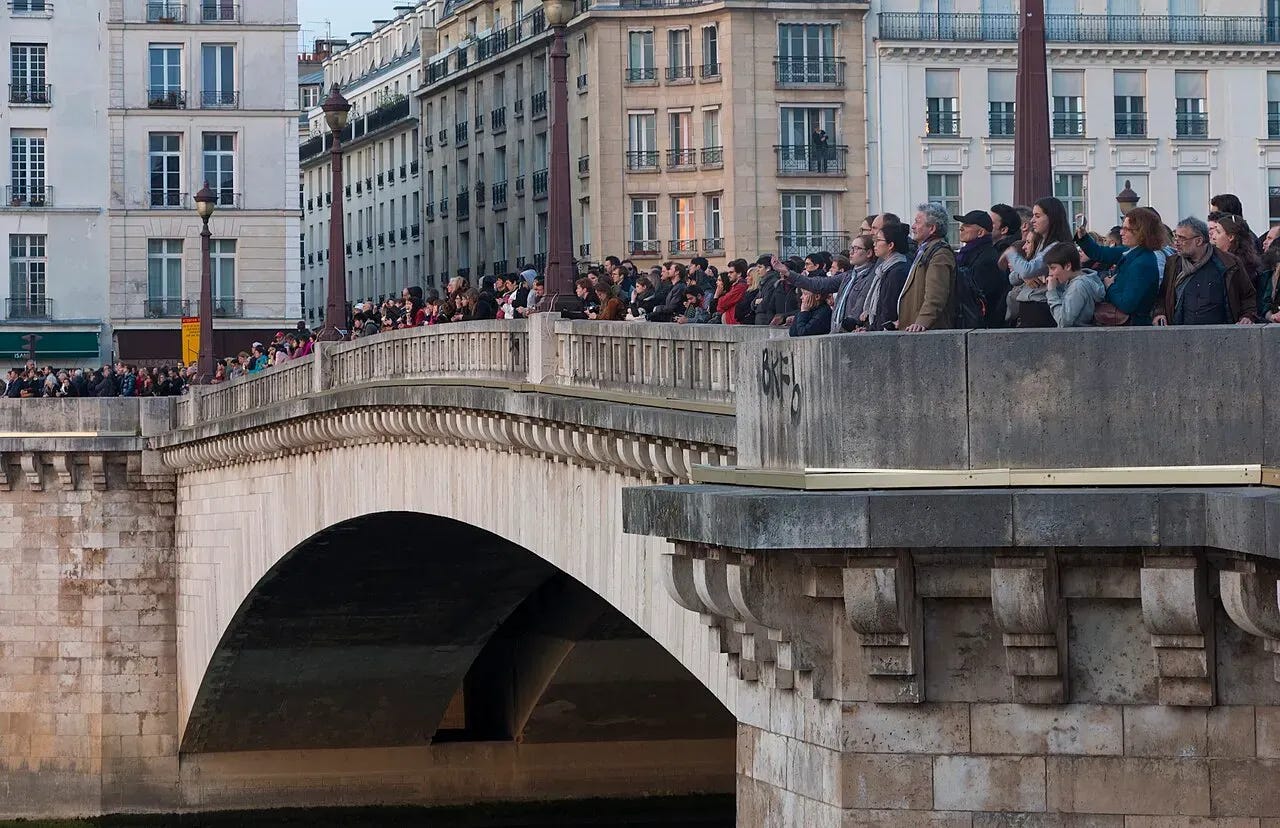
Along the Seine, thousands of people hold up their phones. At 6:52 p.m., one of the first tweets goes out, "I think Notre Dame is burning," and the world arrives faster than the fire trucks.
General Gontier steps out of his car. He lifts his head toward the spire, in flames from top to bottom. Three seconds, then he turns away.
Seen from the square, the whole shape of the cathedral is plain at a glance: the two square towers of the facade in front, the long roof of the nave behind them, and under that roof the attic, where the frame is burning. Halfway up, a stone gallery links the two towers.
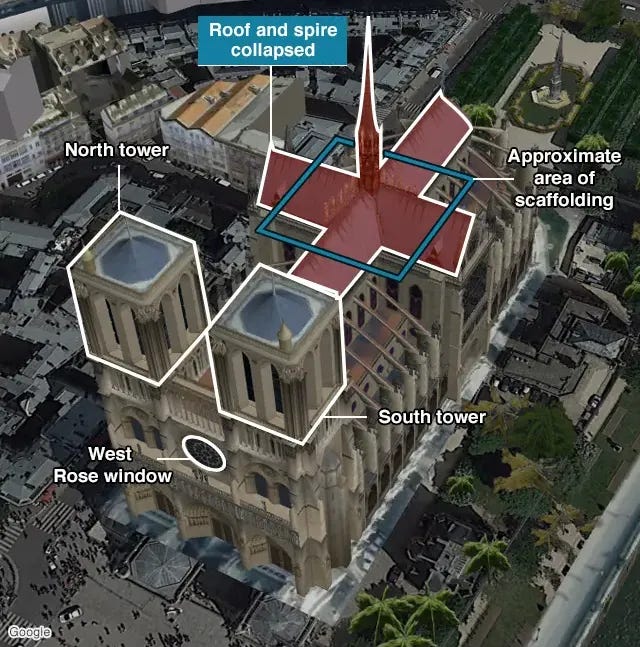
Inside those towers, firefighters are already climbing the spiral stairs toward the fire. Shoulders against both walls, air tank scraping the stone, torso turned sideways to pass the man coming down: two feet wide, 300 steps, 45 pounds on their backs.
Among them, a 39-year-old staff sergeant, Rémi Lemaire, is climbing the south tower. From the window where he leans, the other tower is at eye level, with the gallery running between the two across the void. He looks at it for a long time.
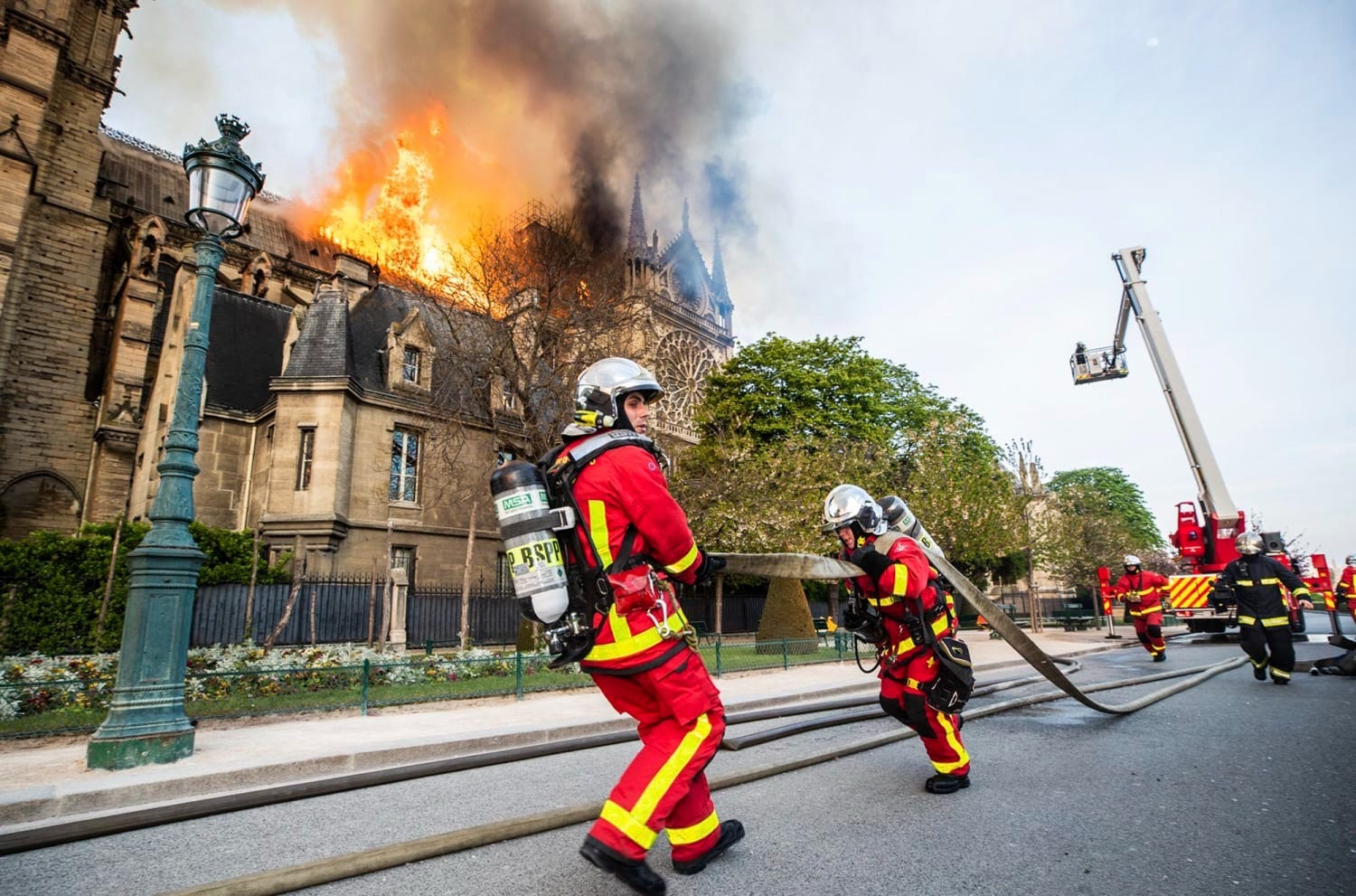
At the top, level with the roof, a 27-year-old corporal pushes open the door to the ledge. In front of her, everything is burning, and in the time it takes her to get her line into position, the fire has gained a hundred feet. She falls back, sets up again farther on, falls back again.
"We look ridiculous, with our two little hoses."
Behind her, the man holding the line watches the flames all lean the same way.
"The wind is turning. It's heading for the north tower."
The fire begins to flank them. They pull back into the attic, where the air is so hot she has to put on her mask and breathe from her tank.
At 7:15 p.m., General Gallet sets up a hundred yards from the square, facing the cathedral. In less than an hour, the fire has taken two thirds of the roof. Three priorities, in that order: the people, the artworks, the cathedral.
Fifteen minutes later, he warns the mayor and the rector: the artworks must come out.
The Fireball
About twenty minutes later.
On every major channel in the world, regular programming stops. CNN, the BBC, television networks across Europe and Asia are broadcasting the same live image: Notre-Dame in flames in the middle of Paris.
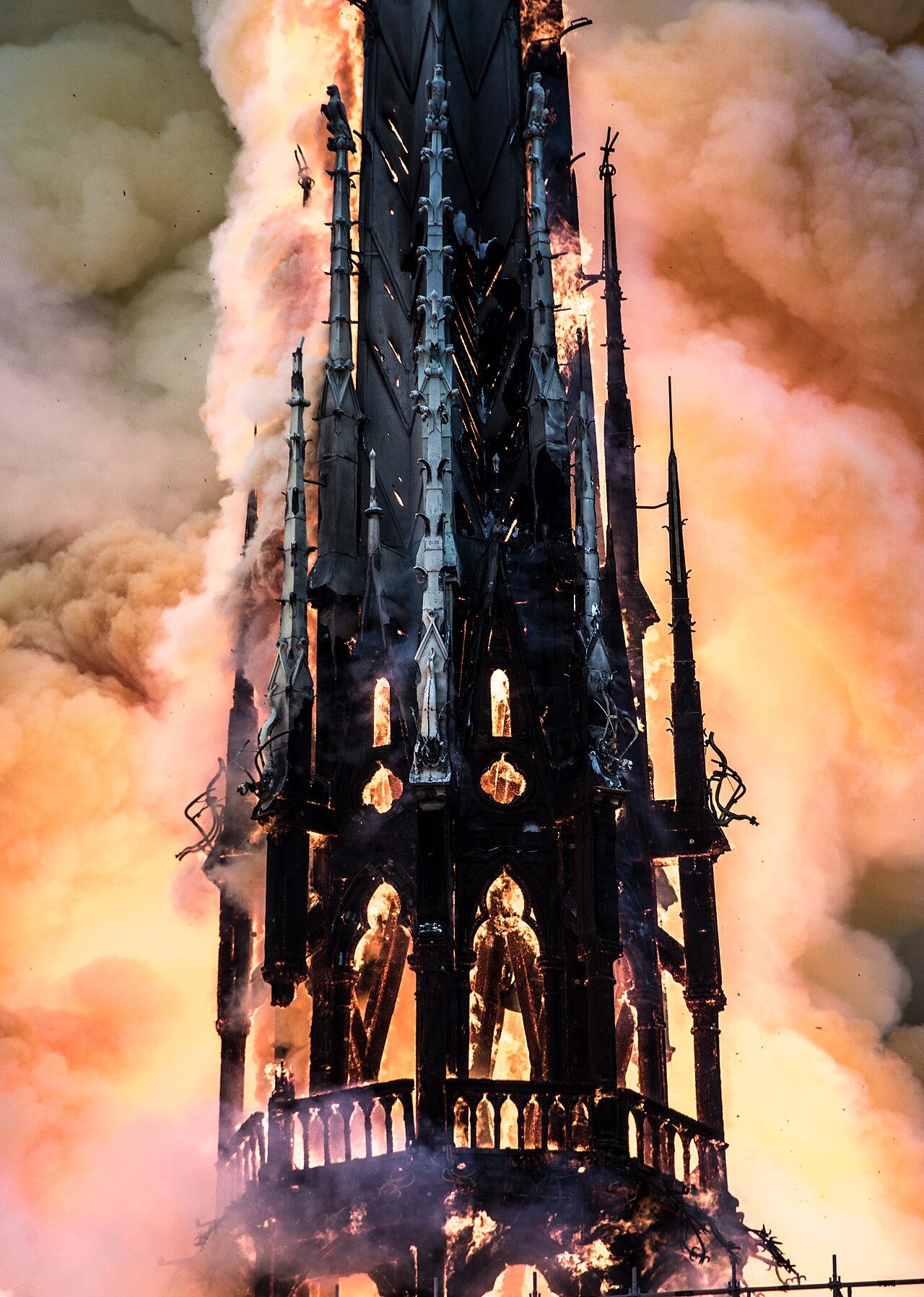
The fire now engulfs the entire spire: 300 feet of wood and lead, designed by Viollet-le-Duc in 1859. The lead melts and runs down the slates. The spire leans, breaks, falls onto the roof and punches through the vault.
From the square, the spire is hidden by the trees and the towers. What carries is the sound of the crowd.
In the attic, the crash runs the length of the frame. The blast slams every door in the cathedral at once.
A ball of fire sweeps through the attic. Some men are behind a wall. The wall saves them.
At the command post, contact is lost with the men inside. General Gallet is already counting his dead. Ten seconds, then the radio crackles.
"We're good. Everyone's accounted for."
The fire is inside now. Lead is running into the nave; a second fire has started on the floor. The crossing of the transept, which anchors the flying buttresses, has come down.
General withdrawal from the upper levels. The lines on the ground pump water into a nave where the drops evaporate before they touch the floor.
Between the sacristy and the trucks sent by the city, a human chain of firefighters, police officers, and curators passes the artworks from hand to hand under the falling embers.
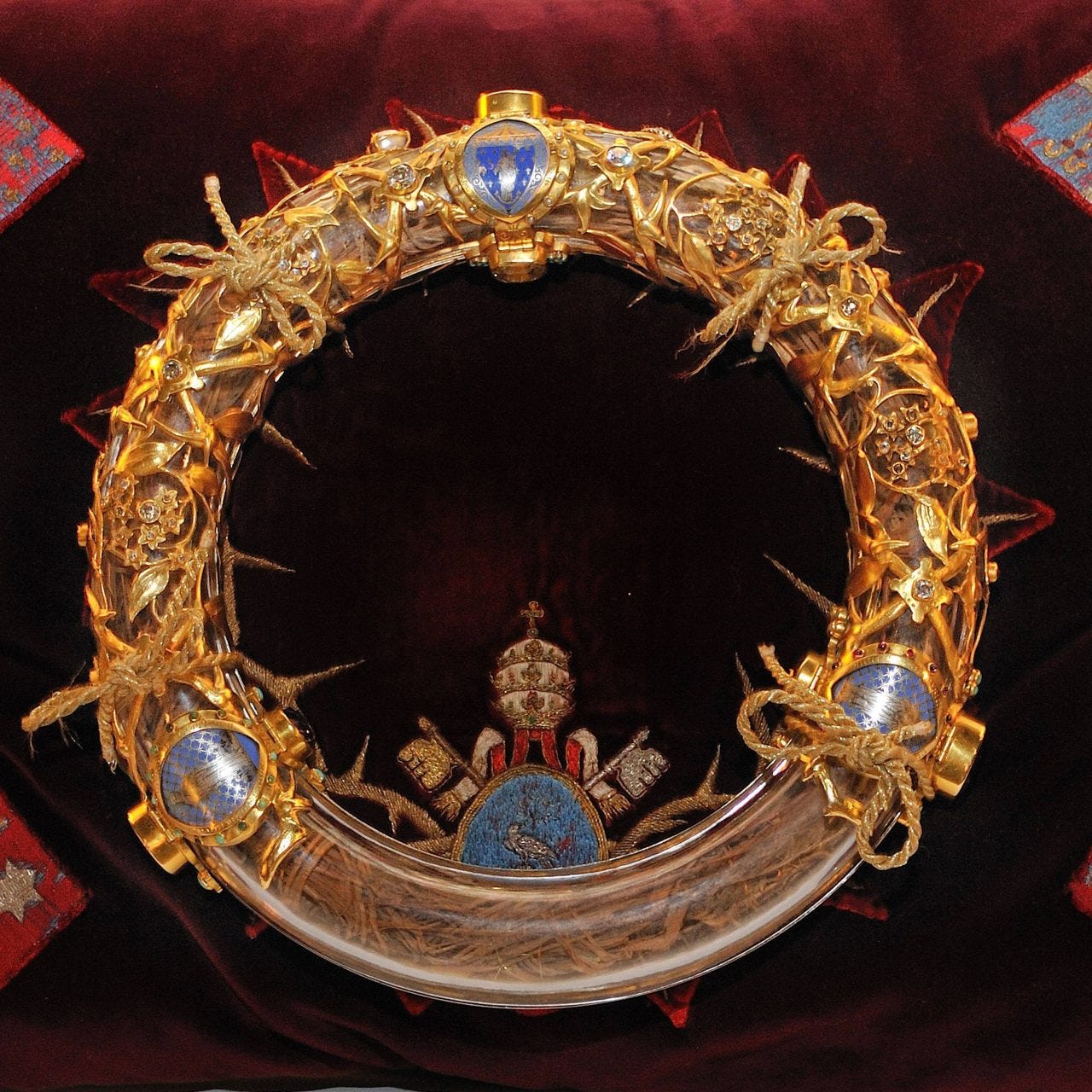
Two relics never leave the curators' arms, held tight the way you hold a small child: the Crown of Thorns, which tradition says was set on the head of Christ, and the tunic of Saint Louis, king of France, seven centuries old.
House of Cards
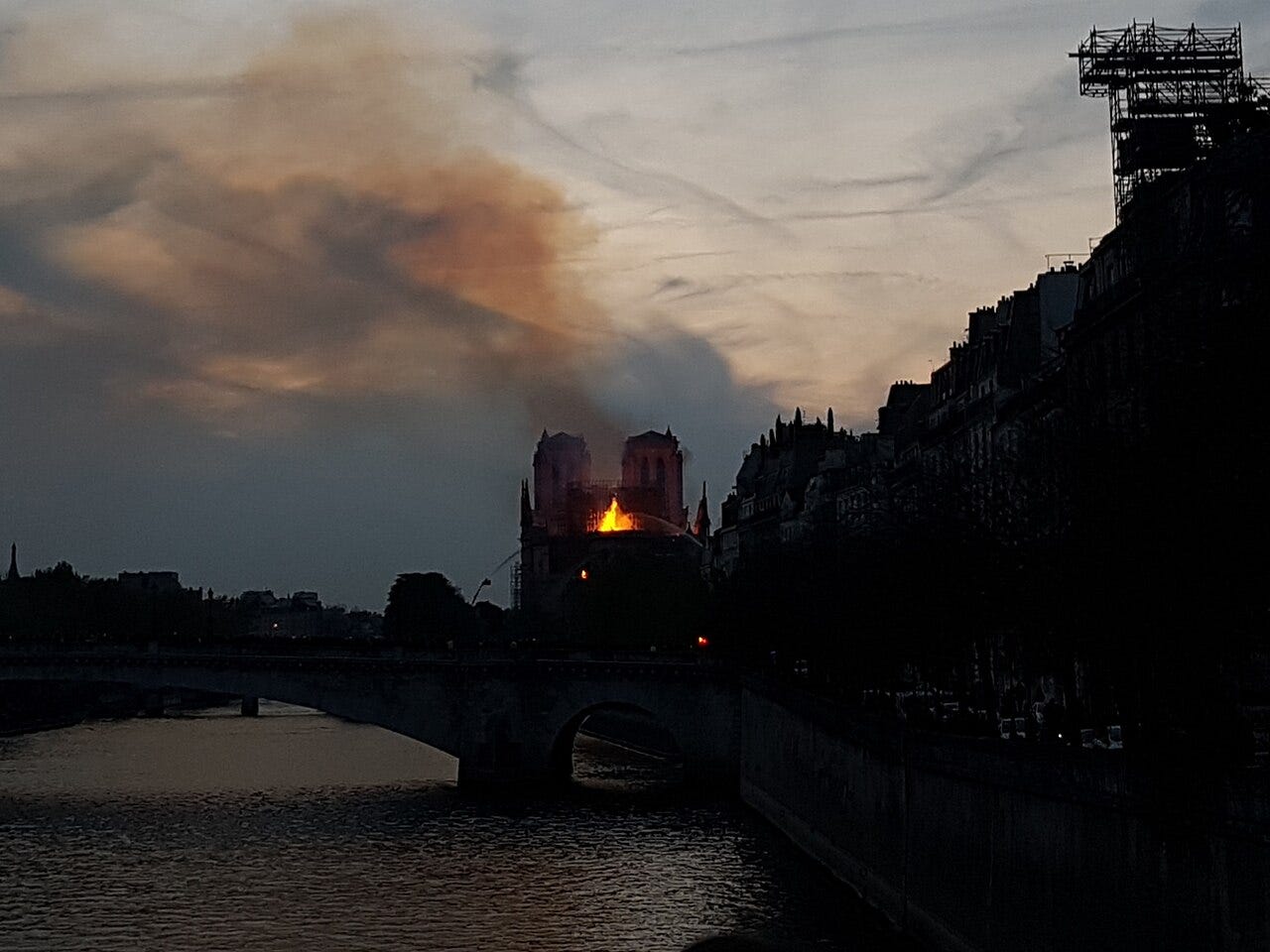
At 9:07 p.m., an hour after the spire fell, a glow appears behind a window of the north tower, halfway up the facade. It grows by the minute.
Under the command post tent, the monuments expert, a lieutenant colonel on assignment to the Ministry of Culture, lays a drone photograph on the table in front of Generals Gallet and Gontier.
"The tower is stone. But inside it, there is a wooden structure as tall as an eight-story building, built to carry the bells. It's called the belfry."
His finger taps the photograph.
"Eight bells hang inside it: almost seventeen tons of bronze. If the wood burns and gives way, they fall down through the tower. Not like bells. Like wrecking balls."
"The north tower goes, it takes the south tower with it, and together they bring down the cathedral. A house of cards."
General Gontier repeats the same sentence twice, to no one.
"We must save Notre-Dame."
Two More Hoses
A few minutes later, under the same tent.
Staff Sergeant Rémi Lemaire, back from the south tower, waits for a gap in the radio traffic.
When it comes, he proposes a route to General Gontier: go up the south tower, which isn't on fire, with two hoses connected straight to a fire engine. Cross the gallery that links the two towers. Enter the north tower from there, and attack the belfry from inside.
He says it twice, the second time more slowly, tracing the route with two fingers on the table.
General Gontier listens. He commands from the square, but he has gone up several times during the evening to see the fire up close, and his gear is still smoking: he knows how narrow those stairways are, how hot it is up there.
He approves the route. The decision to send men in under the bells is made just across the square, at police headquarters, where General Gallet is expected.
Save or Perish
Twenty or so officials in a room. The French president, Emmanuel Macron, is there.
Prime Minister Édouard Philippe turns his thumbs in slow circles. The rector of the cathedral is crying. The police prefect waits.
General Gallet walks in wearing his fire gear, dripping. He lays diagrams and drone photographs on the table, and he begins with what he is giving up: the roof frame is lost, he lets it burn; everything he has goes to the towers.
"Mr. President, the fire has entered the north belfry. The whole structure could collapse. We have to try to get inside."
"The operation is risky, and if it comes down, everyone could die in there. But it is the only way."
Three months earlier, in January, a gas explosion on Rue de Trévise took two of his men.
"I've already lost two men on operations this year, and our motto is Save or Perish. I'm going to send men in again. It puts them at risk, but I have to do it."
"In twenty minutes, I'll know whether we've lost her."
"How would you rate the risk of collapse?" asks the police prefect.
"High. But if we do nothing, the entire cathedral comes down."
"If we want to save the cathedral, we have no other choice."
Many stare at their shoes. President Emmanuel Macron says nothing. He looks hard at General Gallet, then nods.
General Gallet walks out and finds his deputy on the square.
"It's a go. Send them in."
General Gontier has the radio in one hand. He does not answer right away.
Outside the Tent
General Gontier gathers his officers.
"We go up the south tower, we cross the gallery, we enter the north tower and we climb to the level of the bells. The floor is burning in there, and the structure can give way."
A pause.
"Who's going?"
The question hangs in the air. No one moves.
Helmets under arms, soot lines from their masks across their cheeks, gear steaming in the cold air. Eyes drop to gloves, to boots, to the ground.
Behind them, the lines are still pouring water, the radio talks to itself, and along the Seine, hundreds of voices are praying in song.
One of them answers. He commands a crew from a suburban town. He does not raise his voice; he explains nothing.
"We're not going in."
General Gontier does not flinch. His gaze moves from face to face, and he asks the question again, in almost the same words.
Behind the windows of the north tower, the glow is growing.
A voice, somewhere in the group.
"I'll go."