

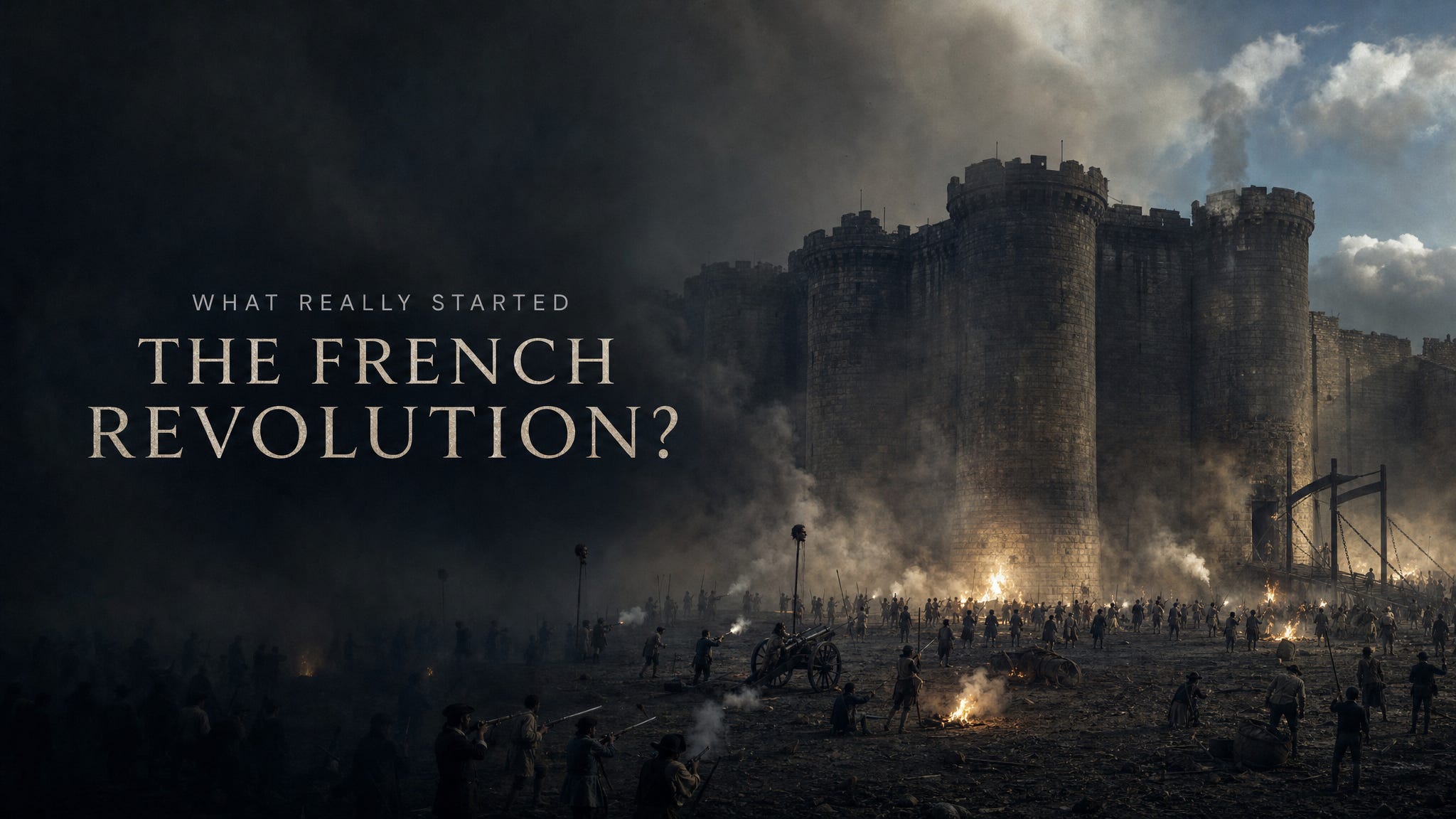
Learn History the fun way.
This is a preview. Paid subscribers get the full story.
You’ll also get:
6 new stories / month
The full archive
Comment, ask questions, DM me anytime
iPhone user? Subscribe at coolstoriesabouthistory.com, not via the app. Apple adds +30% to the price.
Paris, July 14, 1789. 10 a.m. A man scales an iron gate, the gate of the Hôtel des Invalides, the great hospital where King Louis XVI houses soldiers too old to serve, and where weapons are stored. He tumbles over the bars and runs for the cellars.
Behind him, the gate bends under the weight of the crowd, then gives way. Men pour in after him and come back up loaded with muskets.
An iron bar hammers against the powder magazine. The door bursts open. Behind it, nothing: the powder has left the Invalides for the Bastille, a fortress on the east side of Paris where the king locks away his prisoners. Without it, the muskets are worthless.
A cry goes up: "To the Bastille!" The crowd sets off, muskets on their shoulders, and all along the column one name passes from mouth to mouth: Necker.
Necker, a banker. Until three days ago, he ran the king's finances, and Paris loves him: France has just fought a war in America, alongside the Americans against England, and he paid for it by borrowing, without levying a single new tax. The king has just thrown him out.
In the column, a man in a leather apron raises his fist and names the culprit: the queen, Marie Antoinette, born an Austrian princess, "the Austrian woman," as Paris calls her. "The Austrian woman emptied the treasury!" Other voices take it up: her gowns, her parties, Necker dismissed because of her. "And the king lets her do it!"
The rue Saint-Antoine opens before the column, and at the end of the street, the towers of the Bastille blot out the sky.
Before the Drawbridge
11:30 a.m.
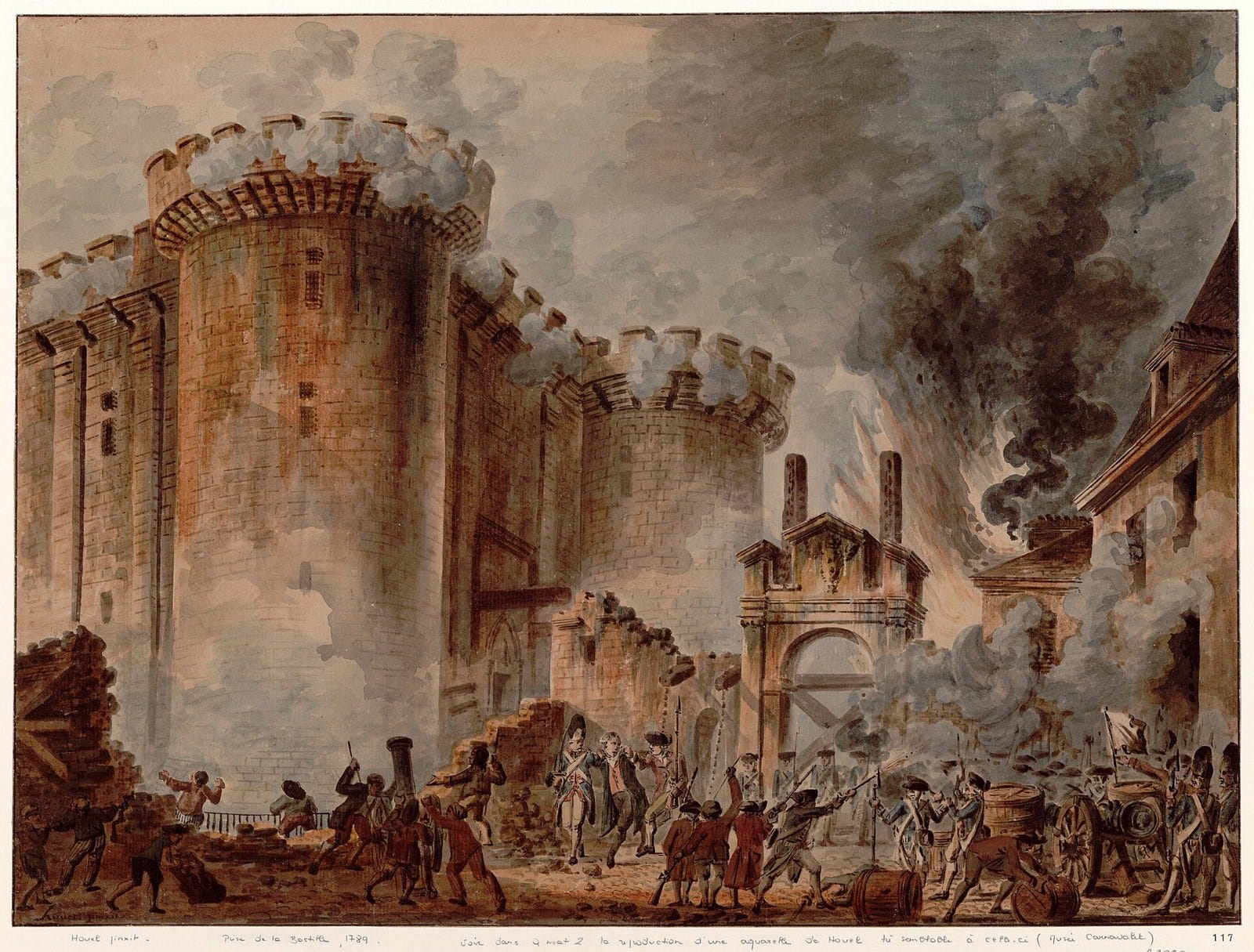
An envoy from the Paris city hall walks out alone onto the drawbridge and enters the Bastille. The door closes behind him. He has come to demand the powder from the governor, the officer who commands the fortress.
Outside, the crowd waits beneath the cannons of the towers. Paris wants weapons to defend itself: more than 20,000 of the king's soldiers are camped at its gates. And for months, Paris has not had enough to eat: hail flattened the wheat, winter froze the Seine, and bread eats up more than half a worker's wages.
Then the door opens again, and the envoy crosses back over the bridge empty-handed. "Well?" someone shouts. "Nothing. He won't budge."
A rumble sweeps the crowd, and a cry pierces it: "We want the Bastille!" Muskets rise above the heads. On the towers, the governor's soldiers level theirs.
The Axes
1:30 p.m.
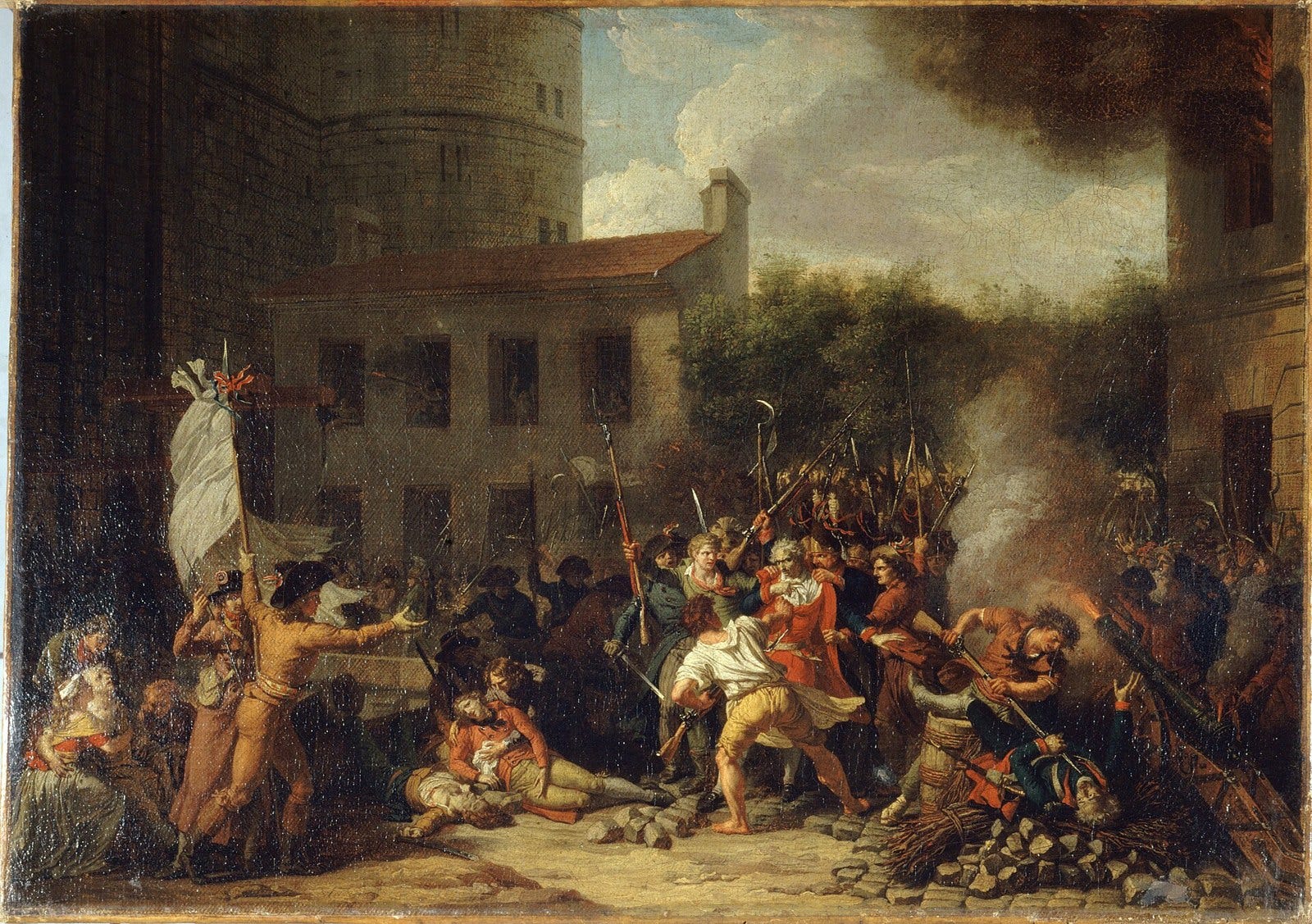
Two men climb up to the chains of the drawbridge and strike with axes. The iron bites. The chains give. The bridge crashes down with a roar that drowns out the shouting. It leads into nothing more than a courtyard. At the far end, behind a great closed door, stands the fortress itself. The crowd surges toward that door.
From the top of the towers, the gunfire erupts. Bullets ring off the paving stones, a man collapses, another crawls. Firing. Falling. Firing again. For hours, nearly 100 attackers die at the foot of the walls.
3:30 p.m.
Boots pound down the rue Saint-Antoine, and uniforms burst into view, cannons rolling behind them. Heads turn, the shouting dies: the king's army is here.
Then the soldiers cut through the crowd, line up beside it, and swing their cannons around to face the fortress. Paris understands: these French Guards, the regiment the king pays to hold the capital, are going over to the crowd.
5:30 p.m.
The garrison surrenders. The great door opens, the crowd rushes in, and the governor falls into its hands. They seize him. They beat him. They kill him.
The Bastille has fallen. The French Revolution begins: the people have taken up arms, the monarchy reels. That is the story told by textbooks and movies: a plump, weak king, a frivolous queen squandering the kingdom's money, fat nobles who pay not a penny in taxes and live it up in their châteaux, and a starving people who finally rise up.
Father to Son
And yet hunger had never made a revolution. In 1693, then again in 1709, brutal winters froze the wheat across the whole kingdom. The first famine killed more than a million French people, the second about 600,000. There were riots, and Louis XIV stayed on his throne.
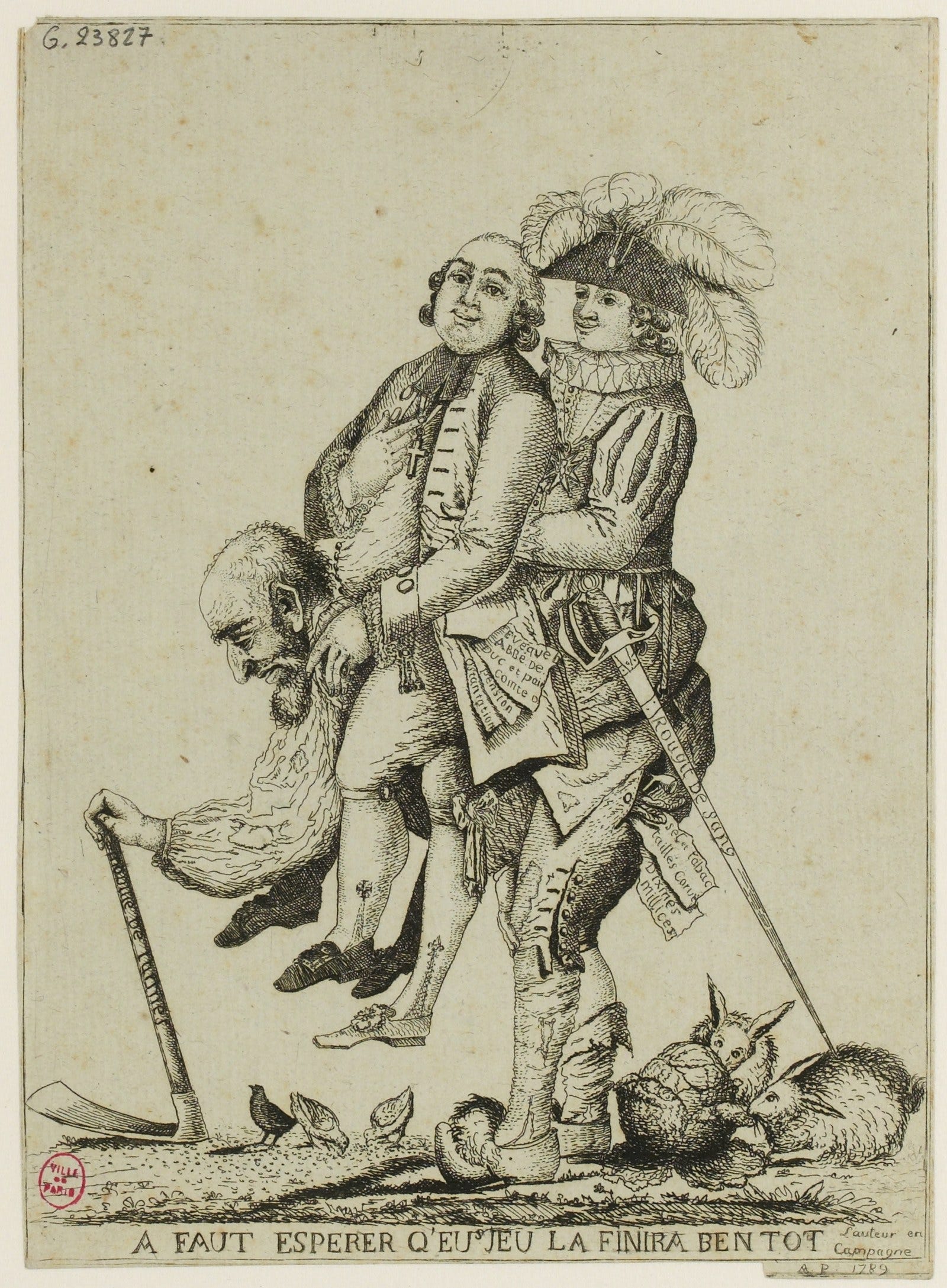
Privilege was nothing new either. For more than three centuries, the nobility and the clergy had not paid the taille, the kingdom's main tax, and the people had paid it for them. They had learned to live with it, father to son.
And the people were not demanding a revolution. In the spring of 1789, the king asked every village in France to write its grievances in a notebook. The peasants asked for lower taxes and cheaper bread. Almost everywhere, they thanked the king. Out of tens of thousands of notebooks, not one called for the end of the monarchy.
The French Revolution was not born of the people's anger.
You are about to find out:
Whether Marie Antoinette really bankrupted France.
Whether Louis XVI was really a weak king.
What the American war has to do with the storming of the Bastille.
Who really won the French Revolution.
What really set off the French Revolution.