
As late as 1964, some Americans still had to pay a tax before they could vote in a federal election. It took the Twenty-fourth Amendment to the Constitution to abolish that poll tax. Taxes like it rarely looked strange to the governments that created them, because they raised money fast or pushed people to change how they lived. The people who had to pay often saw them very differently.
Cool Stories About History is a newsletter to learn history the fun way.
Join free and get:
6 new stories a month, straight to your inbox
The full archive of stories
Comment, ask questions, and chat with other readers
How These Were Chosen
A tax, in these stories, is any payment a ruler or a government forced people to make. It could be paid in silver, in goods, in feathers and chili peppers, in lost inheritances, or in boys taken from their families.
Each charge was real and fell on real people. One story is a medieval legend, kept because it grew around a toll that truly existed. Another shows an ordinary income tax turned against a gangster.
The cases most familiar to American readers come last.
12. Peter the Great's Beard Tax (1698 to 1728)
A massive barber's razor was the surprise at the reception Tsar Peter the Great of Russia gave his court after a long tour of western Europe. He shaved his guests himself, and the commander of his army was among them.
The razor touched a matter of faith. The Russian Orthodox Church taught that man was made in the image of God, beard included, so shaving was a grave sin.
In 1698 Peter put a price on that faith. Every man except priests and deacons had to shave or pay a yearly tax, from a few kopecks for a peasant to 100 rubles for a noble or a merchant.
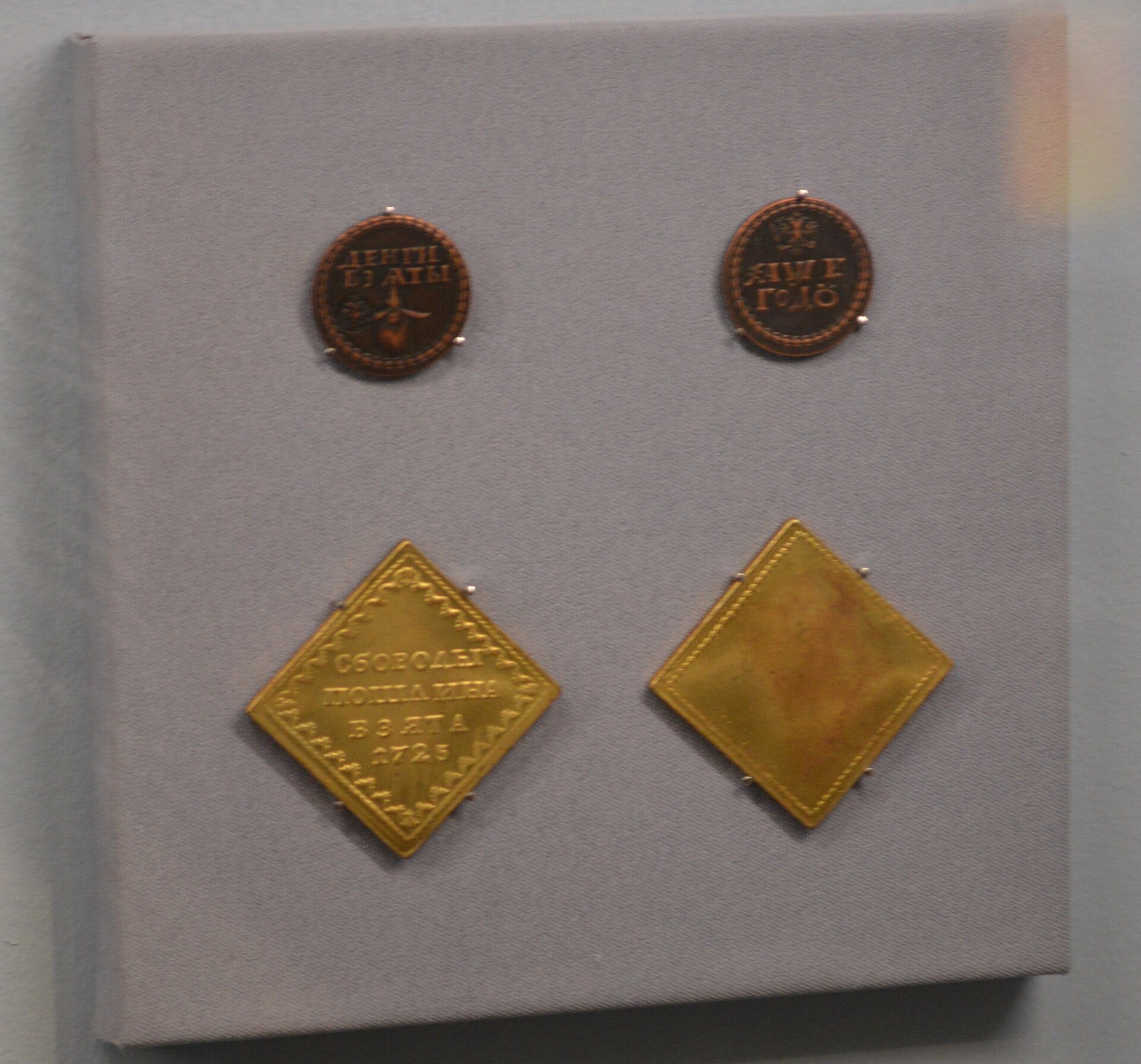
From 1705, a man who paid had to carry proof. It was a copper token with Russia's double-headed eagle on one side, and on the other a mustache, a beard and the words "money taken." Patrols fined or arrested any bearded man without one.
Many Russians resisted. That same year the musketeers of Astrakhan, a city in southern Russia, revolted "for the Christian faith, and against shaving and foreign dress," and hundreds died in the uprising.
Others obeyed and grieved. One carpenter, forced to shave, kept his cut beard so it could be laid in his coffin, because he wanted to account for it to St. Nicholas after his death.
In 1724 the peasants who farmed the land were freed from the tax. Four years later most of the tokens struck in 1724 were melted down to make kopecks, and one from 1705 is now in the British Museum in London.
At a Glance
Who: Peter the Great, tsar of Russia
Tax introduced: 1698
Rates: From a few kopecks for peasants to 100 rubles a year for nobles and merchants
Proof of payment: A copper token, carried from 1705
Where to see it today: British Museum, London
11. Sokollu Mehmed Pasha, the Boy Taken as Tax (1505 to 1579)

The Ottoman Empire collected one of its taxes in boys, and its agents took Christian boys as young as ten from the Balkans. One of them, born in 1505 in the Bosnian village of Sokol, became known as Sokollu Mehmed Pasha. How far could a child handed over as tax rise?