

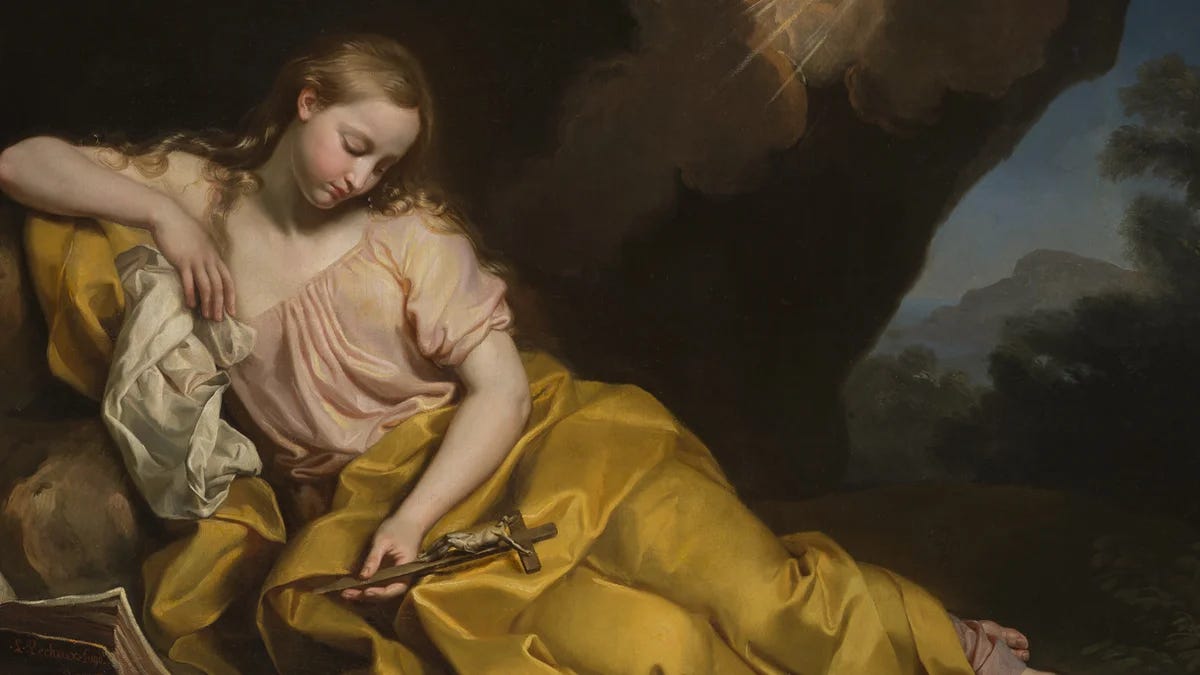
Learn History the fun way.
This is a preview. Paid subscribers get the full story.
You’ll also get:
4 new stories / month
The full archive
Comment, ask questions, DM me anytime
iPhone user? Subscribe at coolstoriesabouthistory.com, not via the app. Apple adds +30% to the price.
A crowd of men surrounds a woman thrown to the ground, her hair loose in the dust, and every one of them grips a stone. One man parts the circle, stops in front of her and draws himself up facing the others, without a word. Arms lower one after another, and the stones fall to the ground, one by one.
The man is Jesus. The woman is Mary Magdalene, and in Martin Scorsese's film The Last Temptation of Christ, she is a prostitute.
In movies as in museums, she is almost always given that past: a prostitute whom Jesus forgave. Novels go further still and make her Jesus' wife.
So was Mary Magdalene a former prostitute?
Her story, as churches have told it for centuries, begins with a dinner.
Simon's Table
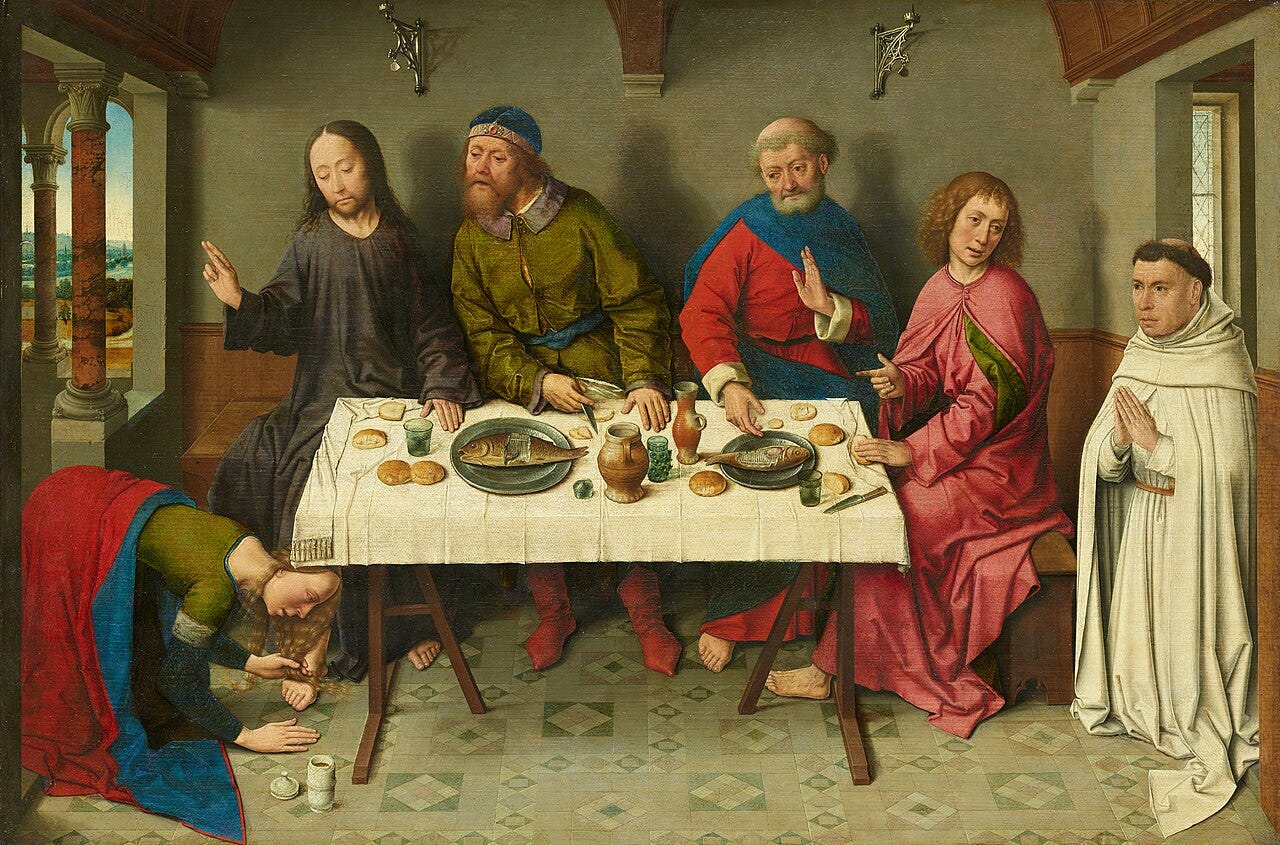
The scene comes from Luke, one of the four men who wrote the Gospels, the accounts of Jesus' life. At the time, Jesus is traveling through Galilee, and a Pharisee has him to dinner. The Pharisees are a group of devout men who follow the Law of Moses down to its smallest details, and the Pharisee hosting Jesus is named Simon.
In the room, the guests eat the way people ate then, reclining on couches around the table, weight on one elbow, feet pointing outward. Jesus reclines among them. Dishes pass from hand to hand, and people talk.
A woman comes in, uninvited, and Luke introduces her in a few words: a woman from the town, a sinner. He says no more. Around the table, everyone can guess how she earns her living; voices drop, and heads turn toward her, then look away.
She clutches an alabaster jar to her chest, a vessel of polished white stone filled with perfume. She slips behind Jesus, stops at his feet and weeps, and her tears fall on them. She lets down her hair and dries his feet with it, then presses her lips to the feet she has just dried and pours her perfume over them.
Simon says nothing as he watches her, and he thinks: if this man were a prophet, he would know who is touching him, and what kind of woman she is, a sinner.
Jesus turns to him. "Simon, I have something to say to you."
"Tell me, teacher," Simon says.
A moneylender has two debtors, Jesus says. One owes him five hundred silver coins, the other fifty; neither can pay, and the lender cancels both debts. Which of the two will love him more?
"The one who was forgiven more, I suppose," Simon answers.
"You have judged correctly," says Jesus.
Then Jesus points the woman out to his host. "Do you see this woman?" When Jesus came into the house, Simon gave him no water for his feet; she washed them with her tears and dried them with her hair.
Simon gave him no kiss; she has not stopped kissing his feet since he came in. Simon poured no oil on Jesus' head; she poured perfume on his feet. And Jesus concludes: her many sins are forgiven, because she has loved so much.
Then he turns to the woman. "Your sins are forgiven." Around the table, the guests lean toward one another: Who is this man, who even forgives sins?
Jesus does not answer them. "Your faith has saved you; go in peace." She rises and leaves the room, and the jar sits there at the foot of the couch, empty.
Remember that jar of perfume.
Against the Dark
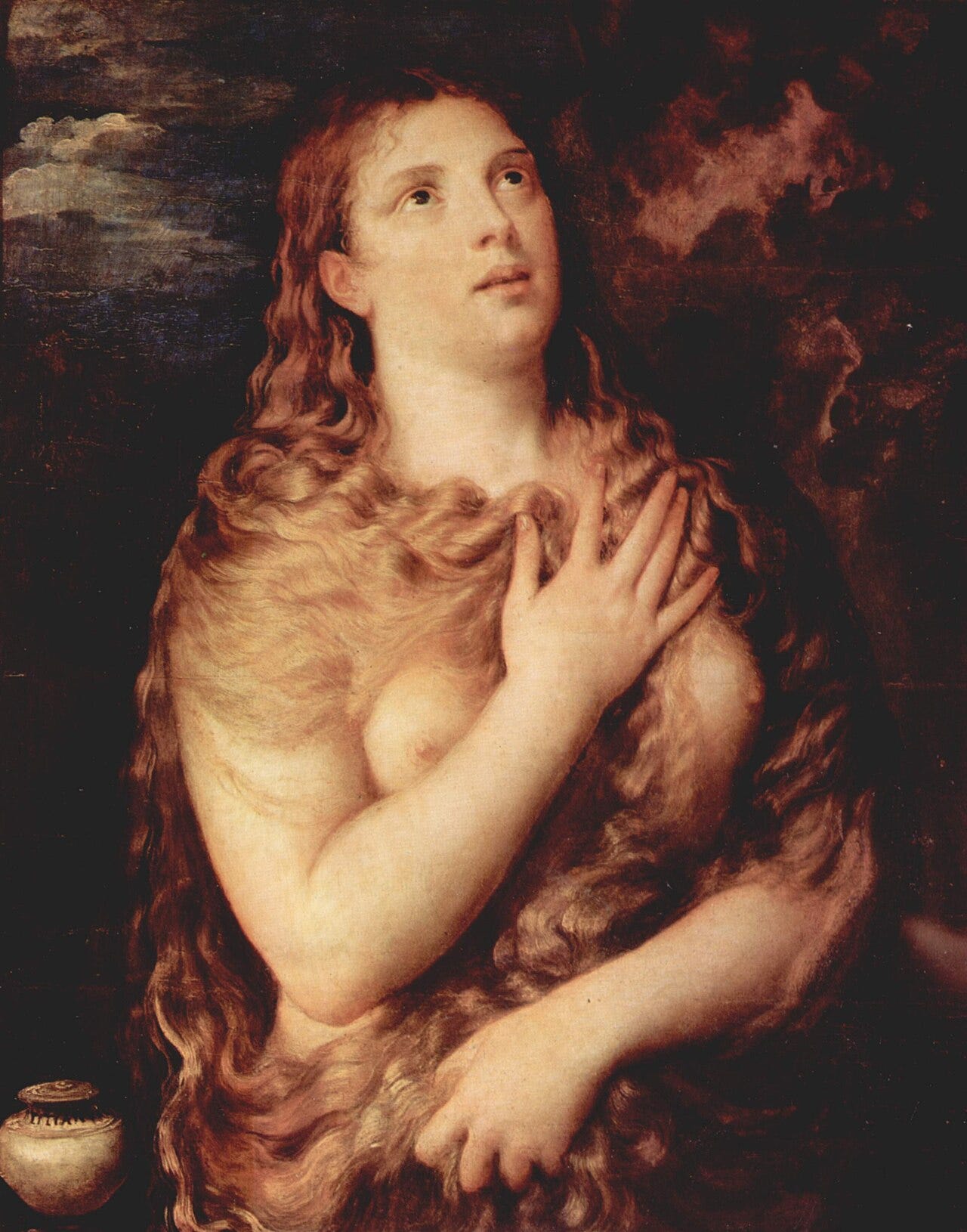
You have surely seen her before: the woman with unbound hair and a jar of perfume. Five centuries ago, in Venice, a duke commissions a Mary Magdalene from Titian, one of the greatest painters of the Renaissance. He wants to give it to a deeply pious woman poet.
Titian paints her alone against a dark background, and he paints her nude. Her long golden hair falls over her shoulders and chest, concealing nothing. Her eyes, full of tears, lift toward heaven, and beside her rests the jar of perfume from the dinner. He gives her the body of a classical Venus, the goddess of love.
Other painters had undressed her before him, but Europe remembers his Magdalene, and centuries later artists are still copying it. The painters who come after him waver between two Magdalenes, the weeping penitent and the desirable woman caught mid-repentance, and almost all their canvases tell the same story: a woman who sinned with her body and asks forgiveness for it.
The same signs identify her in churches and museums alike, and all of them come from the dinner: the unbound hair, the tears, the jar of perfume.
In English, her name even became an ordinary word more than three centuries ago. A magdalen is a repentant prostitute. And the same name gave us maudlin, meaning tearful, because she was painted in tears.
The paintings, the tears, the jar, the word all rest on a single scene: the dinner at Simon's.
Yet go back to the text itself, and the woman who wept and poured perfume at that dinner has no name.
Mary Magdalene's name does not appear until the next chapter.
So was the woman at the dinner really Mary Magdalene?
You'll discover:
Who washed Jesus' feet, if it was not Mary Magdalene
Whether Mary Magdalene was Jesus' wife
Where Mary Magdalene lies buried today
Why painters show her nude
Whether she was really a former prostitute