
Christmas became a federal holiday in the United States only in 1870. Most of what Americans now do in December took its present shape in the same century, and much of it crossed the Atlantic from Germany and Britain. Many of these customs began with one person, in a year the records still show, and several of the best-known stories about their birth turn out to be wrong.
Cool Stories About History is a newsletter to learn history the fun way.
Join free and get:
6 new stories a month, straight to your inbox
The full archive of stories
Comment, ask questions, and chat with other readers
How These Were Chosen
Ten of the twelve are customs found in American homes and churches every December, from the Advent wreath to Santa Claus. The other two are about the holiday itself: how it came to fall on December 25, and why Massachusetts once made it a crime.
Only traditions whose first appearance can be dated from reliable records were kept. Where a popular origin story clashes with those records, the records win.
The least familiar come first, and the last is the figure every American child waits for.
12. The Advent Wreath: Johann Hinrich Wichern (1839)
Johann Hinrich Wichern was a Lutheran pastor in Hamburg, Germany, who ran a home for poor and neglected children called the Rauhes Haus. He had opened it in 1833 with twelve children in a thatched cottage.
In the weeks before Christmas of 1839, the children of the Rauhes Haus could hardly wait for the holiday. Wichern decided to make them a gift that would calm their impatience and show them how long the wait still was.
That wait has a name in the church calendar. Advent is the season that leads up to Christmas, and in 1839 it began on Sunday, December 1. From that morning, Wichern's gift hung in the home's prayer hall.
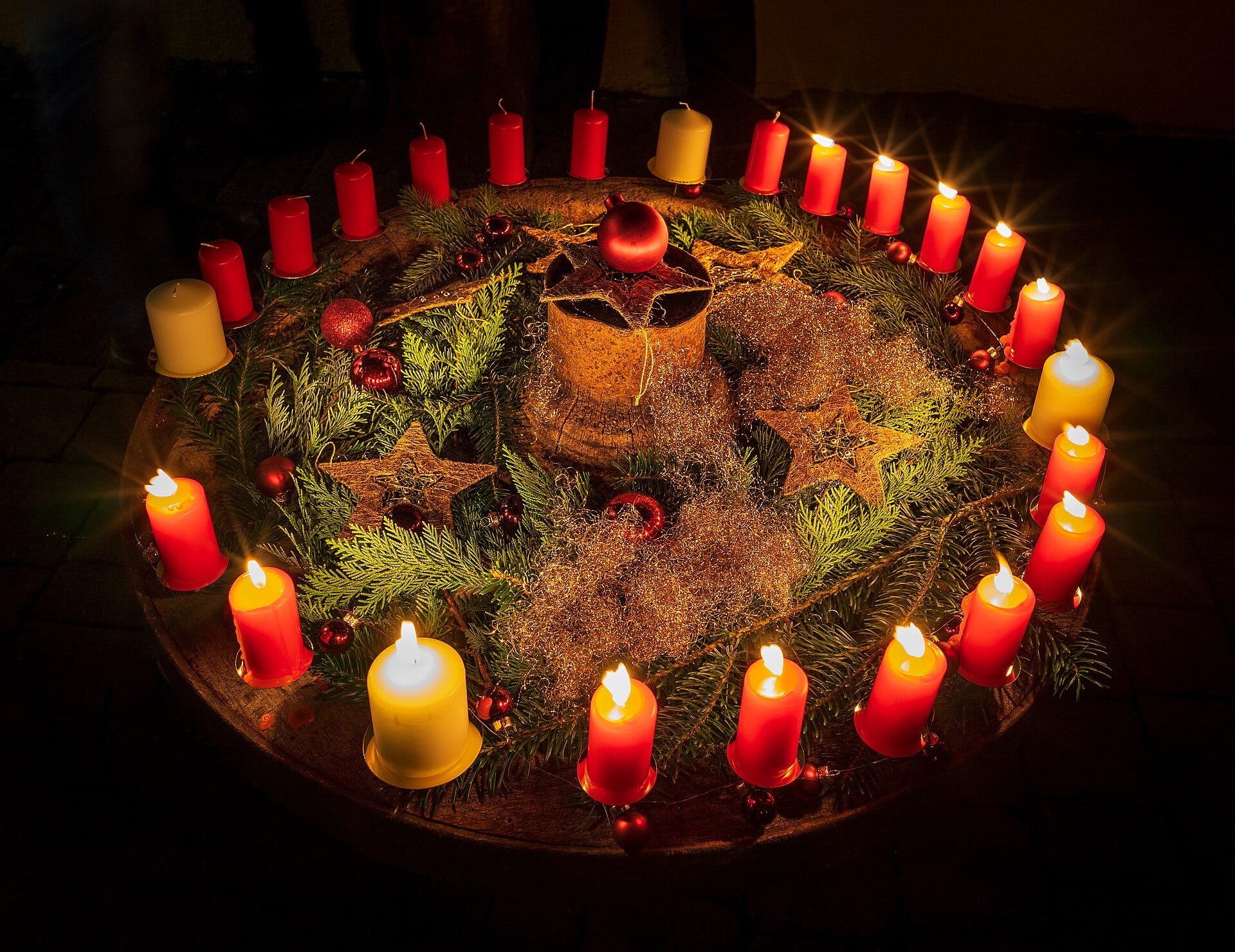
It was a wooden wagon wheel carrying 24 candles, 20 small red ones and four large white ones. Starting on the first Sunday of Advent, one more candle was lit each day, a red one on weekdays and a white one on Sundays.
The count matched the calendar exactly. From December 1 to Christmas Eve, 1839 had 24 days, four of them Sundays. The candles still unlit told the children how many days were left.
It took two more steps to turn the wheel into the wreath sold today. Around 1860 the wooden ring began to be wrapped in fir branches. In the early 1900s the wreath moved into middle-class living rooms, usually with only the four Sunday candles.
Wreaths built on Wichern's model still follow the calendar, so their number of candles changes every year. In 2009, when Advent began on November 29, one held 26 candles, 22 small red ones and four large white ones.
At a Glance
Who: Johann Hinrich Wichern, Lutheran pastor (1808 to 1881)
Tradition: The Advent wreath
When: First Sunday of Advent, December 1, 1839
Where: The prayer hall of the Rauhes Haus, a children's home in Hamburg, Germany
The first one: A wagon wheel with 20 small red candles for weekdays and four large white ones for Sundays
11. Electric Tree Lights: Edward H. Johnson (1882)
In December 1882, a Detroit newspaper writer named W. A. Croffut found a Christmas tree spinning in the parlor of a Manhattan townhouse, covered in red, white and blue lights. The house belonged to Edward H. Johnson, a vice president of Thomas Edison's electric light company, and not one of those lights was a flame. How had Johnson lit his tree, and how long would it take before anyone could buy such lights in a store?